

















Like what you see?
The United States Federal Occupational Safety and Health Administration (OSHA) publishes and enforces regulatory standards that help keep workers safe across nearly every industry in the country. Some safety concerns are shared by many of these industries, with perhaps the largest common topic being that of forklift safety. Almost every individual, business, and market sector fall under OSHA Powered Industrial Truck regulations, either directly or through their state’s adopted versions. Because this body of regulatory code is so extensive, we find it helpful to pick out smaller topics to discuss and remind readers of key points that can help keep their employees safe. Today’s topic is a brief overview of OSHA’s Standards for Safe Forklift Maintenance and Service-Related Activities, an area where many of our clients say they could use a refresher – so with that, let’s go!
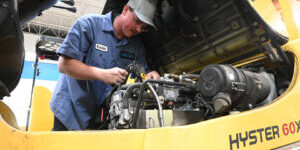
What do we mean by forklift maintenance and service-related activities? Visualize that all topics regarding forklifts are split into two containers. The first container holds all of the topics that involve performing a job with a forklift (“using the tool”), and the second container holds everything else which ensures that the lift is ready and able to perform that job (“preparing the tool”). Here we’re talking about the second container, and specifically, the electromechanical maintenance, pre-operation checkout, operational testing, and facilities involved in preparing the forklift to do its job. According to OSHA, when these topics are proactively, and responsibly exercised ahead of time, they translate into overwhelmingly fewer accidents, fewer lost time incidents, and overall safer workplaces.
All of the safety items we’ll cover below are directly tied to specific code sections found in OSHA’s Powered Industrial Truck standards, which you can find here. Most businesses fall under this general section 1910 Subpart N Materials Handling and Storage, though there are other standards for specific high-hazard industries (marine terminal, seafaring vessel, logging, and more are good examples). For the general industry, OSHA offers a nicely developed E-Tool where readers can find more information, example documents and forms, useful pictures and graphics, and specific standard numbers for everything we’re about to discuss.
Electric Lifts & Batteries
Incredible advancements in electric lift battery technologies have been made over the last few decades, bringing with them unprecedented performance, longevity, and safety. Even still, battery technology presents inherent risks that OSHA implores owners and operators to be mindful of. In particular, OSHA prescribes these key standards:
Hazards particular to the batteries being used in a workplace must be thoroughly understood, communicated, and actively managed. For example, lead acid batteries are heavy, slow to charge, riskier to handle due to their hazardous chemical contents, and volatile enough that they require their own dedicated, restricted storage area. Alternatively, more recent lithium-ion batteries stay installed and charge on the lift but require much more frequent charging and potentially more frequent replacement.
Speaking further about dedicated lead-acid charging areas, OSHA requires extensive safety provisions including active ventilation, fire protection, eyewash and shower stations, emergency communication means, spill-neutralizing kits, and ample personnel protection equipment. Battery-changing equipment must also be provided, typically in the form of overhead hoists and jibs. Lead-acid batteries involve sulfuric acid and hydrogen fumes and must be handled with extreme care.
Lithium-ion batteries offer many benefits over lead-acid batteries but come with a significantly steeper purchase price, much higher electrical infrastructure demand, future Hazardous waste recycling costs, and in certain frequent charging applications, a shorter lifespan. OSHA requires many of the same general safety measures as with any other battery type, but specific requirements related to open-cell lead-acid batteries do not apply since there are no chemicals, fumes, or frequent heavy lifting involved.
Internal Combustion Lifts & Fuels
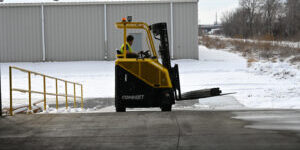
Electric lift trucks are the standard choice for indoor warehouse operations, avoiding concerns of internal combustible emissions causing workers respiratory harm. But for outdoor material handling and especially where rough terrain and heavy loads are found, internal combustion (IC) fork trucks dominate. OSHA has a series of safety standards for just these applications, the most compelling of which include:
As IC fork trucks run on propane, diesel, liquified gas (LPG), or gasoline fuel, OSHA begins their standards with all the usual suspects concerning combustible fuels. These standards require safe fuel handling, appropriate fuel containers, restricting flame and spark ignition sources, ventilating toxic fumes, and protection against contact exposure.
Next, OSHA warns users against the dangers of combustion emissions, requiring proper and ample ventilation to dispel carbon monoxide produced by IC engines. This requirement even applies outdoors, as some unique operating environments do not receive sufficient airflow to dissipate fumes. In addition, this requirement extends to spilled fuel and other fluids that might present a hazard, either from fume release or slip-and-fall accidents.
Refueling IC lift trucks presents additional hazards that OSHA regulates against. Refueling must be performed in a properly designed, designated, protected area where ignition sources and major spills can be safely mitigated. Further, refueling areas must be located away from heat sources, building air intake, and emergency egress paths so that if an issue were to arise, it would not jeopardize surrounding facilities or people.
Fork Truck Maintenance
Ensuring that a forklift remains in safe, reliable condition is one part maintenance service and one part operator engagement. OSHA has a bit to say on both topics, considering them to be heavily codependent, such as:
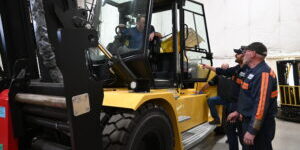
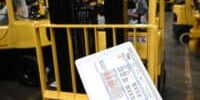
At the beginning of every shift, OSHA requires that an operator performs a thorough Pre-Operation Inspection on the lift they’re to use. This inspection follows a standardized checklist, inspecting for and checking off things like fluid, tire, fuel/battery, safety device, and overall lift conditions. The operator’s goal is to take responsibility for their own safety on this lift. If any unsafe or unsound conditions are identified during the inspection, the operator must tag the lift out for service, and use another lift for the day’s work.
Once a lift is cleared for use by the Pre-Op Inspection, OSHA next requires an Operational Inspection. This step involves starting the lift and running its systems through a deliberate testing regime to make sure everything functions as expected. Drive, steering, mast, tilt, brake, horn, lights, alarms, and any special attachment functions must all be tested throughout their range of motion, while the operator keenly monitors for any unusual movement, vibration, sound, warning alarms, or failures. Here again, if anything abnormal is detected, operators must tag out the lift for service right away.
OSHA goes so far as to require any issues found in either of the above two inspections to be immediately reported to supervisors and corrected by authorized maintenance personnel. No industrial trucks may be operated when tagged for maintenance, as they are assumed to be unsafe and dangerous until repaired. Aside from tagged maintenance, routine preventative maintenance and service is also required by OSHA so as to catch problems before they arise. Overall, proper and frequent maintenance reinforced by diligent daily inspections is the only way to assure the safest operations and longest lifespan for your forklift fleet.
MH Equipment is one of the largest material handling service providers in the United States, with 30+ locations and over 900 employees serving customers in upper Mid-West and Eastern states. Our mission is to deliver exceptional service in material handling equipment sales, service, rental, certification & training, emergency response, and engineering. From complete fleet management to warehouse design, vehicle sales to roadside response, our local experts are here to serve your needs. For more information or to discuss your application, please call us at (308) 210-7387, visit our website here, or email us here.
Posted in Safety
We are here to help.
Count on our friendly support team to provide the guidance you need. (308) 382-3585
