























Like what you see?
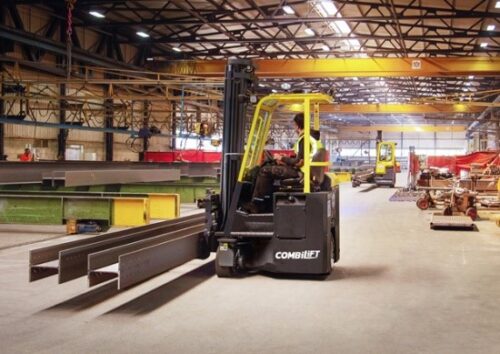
Unless you’re a stunt car driver, a good day behind the wheel of any vehicle includes keeping all wheels on the ground at all times. This is especially true for drivers of industrial forklifts working in the supply chain, where the heavy load weights and small vehicle footprints present a uniquely greater risk of accidents than other vehicles. Every forklift is designed to safely operate within very strict engineering parameters such as load weight, size, distribution, shape, travel speed, and lift height. Any time that a lift is operated outside of these parameters, safety can no longer be guaranteed, and the risk of accidents skyrockets. Too often, operators push the limits on their lifts and exceed these safe operating parameters without knowing it, simply due to lack of familiarity with lift stability. Understanding lift stability is a critical building block of safe forklift operation, no matter the industry or application, as we’ll break down in detail below.
Our discussion will center on these three terms:
- Load Capacity – this value describes the maximum load weight that a forklift is designed to lift safely.
- Load Balance – this refers to the proper distribution of a load’s weight on a forklift, such that the lift is fully and evenly grounded on all tires.
- Load Stability – this refers to the load’s resistance to unexpected motion or inertia that could cause a lift to handle poorly or tip over. A load that is within a lift’s capacity and is balanced on the forks provides the best assurance that the forklift will remain stable and safe during transit.
Forklift capacity, balance, and stability are not arbitrary concepts, but are instead very tangible, technical criteria that all operators must thoroughly comprehend. The federal Occupational Safety and Health Administration (OSHA) requires all operators to be completely trained and certified on the lifts and applications they will handle, and a large part of these regulations involves considering lift stability with every decision they make.
Visualizing Forklift Capacity Limits
With most motor vehicles, the combined weight of the vehicle itself plus any cargo sits squarely within the vehicle’s footprint. This helps achieve relative balance and stability between the vehicle’s tires. A forklift is fundamentally different in this respect, as a lift’s load is held out in front of its footprint. This design difference is necessary so that the forks can engage loads freely in front of the lift’s front tires, but does introduce a balancing point known as a fulcrum where the front tires contact the ground.
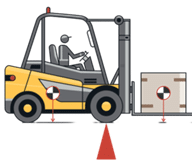
Fig. 1 – Forklift Fulcrum Point
In the image above, we can see the fulcrum point denoted by the red arrow pointing up at the lift’s front tires. At this fulcrum point, the weight of the load and the weight of the lift’s counterweight balance against each other. For loads that are within the lift’s capacity, the heavier counterweight deters the lift from tipping forward on the fulcrum point. For loads that exceed the lift’s capacity, the counterweight is insufficient – the lift will tip forward on the fulcrum point towards the heavier load. As the lift tips, downward force on the rear wheels is reduced, steering and braking fail, and eventually the lift falls forward with the load crashing to the ground.
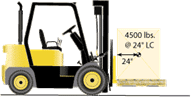
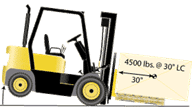
Fig. 2 & 3 – Load Position
Load weight is not the only factor to consider in protecting a forklift’s balance – load position and orientation are equally as important. Using the two images above, we can see the same 4,500 lbs load resting on the lift’s forks in different orientations. On the left, the load is positioned vertically, which keeps the load’s center of gravity close to the lift (at 24” from the back rest). On the right, the load is positioned horizontally, pushing the load’s center of gravity farther away (to 30” from the back rest). While the load weights are identical and within the lift’s overall capacity, the righthand load’s center of gravity exceeds the lift’s stated specifications, which creates too great an extended force away from the fulcrum point and causes the lift to dangerously upend.
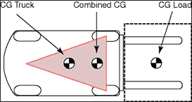
Fig. 4 – Forklift Stability Triangle
Now let’s expand the fulcrum point concept in all directions around the lift. Just as a load sitting too far forward on the forks will tip a lift forward, a load with a center of gravity positioned too far to one side presents a risk of tipping the lift over sideways. Forklifts are designed to tolerate some side-to-side weight distribution variation, which can be visualized with the above graphic that shows a forklift’s Triangle of Stability (shaded gray in the above image). A lift’s stability triangle is the area between the front two tires and the center of the rear axle. For a lift to operate safely, the combined center of gravity between the lift and the load must always fall within the stability triangle. If at any time the combined center of gravity falls outside of the stability triangle, the forklift will become unbalanced, lose all stability and control, and risk an imminent tip-over.
The principles of load capacity, balance, and stability may seem complicated, but there is no excuse for operating a lift with inappropriate loads that put operators and materials in harm’s way. As such, forklift operators must never perform lift actions when they do not know their load’s weight, their lift’s capacity, or the combined center of gravity.
Tips for Ensuring Stable Forklift Operation
While there is no replacement for professional training and practice, here are a few forklift stability tips that operators can keep in mind:
- Read the Name Plate – before ever getting onto a new forklift, operators must read the lift’s data plate thoroughly to understand its rated capacity and load limitations.
- Travel with Lowered Loads – loads should always be positioned as low as possible to ground level whenever the lift is in motion. In most cases, lowering the forks to 4″-6″ above ground is adequate to miss any ground obstructions such as floor irregularities and curbs.
- Brake Early – unless clamped or strapped down, a load is only held on a forklift’s forks by the friction plus any backwards tilt from the mast. For this reason, operators must brake gently and early to avoid the load’s inertia pulling the load forward on the forks and causing a sudden lurch in the lift’s center of gravity.
- Maneuver Slowly – just like with braking early, any other sudden maneuvers such as abrupt turning or acceleration can cause a load to suddenly shift and jeopardize the lift’s stability. Operators should always maneuver slowly and evenly, especially with odd-sized and near-max weight loads.
- Mind Traffic Rules – when designing warehouse and material handling spaces, engineers consider forklift stability as part of establishing safe traffic routes. Speed limits, turning dimensions, load clearances, travel directions, and other traffic rules all consider keeping forklifts firmly on the ground, and must always be minded.
- Face Loads Uphill – when forklifts traverse ramps and inclines with their loads facing downhill, the load is at risk of sliding forward on the forks due to gravity and inertia. This can directly push a lift’s combined center of gravity outside of its stability triangle and risk a tip-over, which is especially dangerous since the lift is inclined to begin with. For this reason, lifts should always drive up and back down inclines with loads pointing uphill.
- De-Rate Odd Loads – unusual load shapes, sizes, weights, and orientations should be treated with caution, as their impacts on the lift’s combined center of gravity and stability during transit may not be obvious. In such cases, operators should follow standard OSHA-approved calculations to de-rate the load’s weight and check against the lift’s capacity.
- Step Over Obstacles – any time that a lift is not firmly and squarely planted on a flat, level surface, the lift’s combined center of gravity will be biased to one side. This is especially true when crossing speed bumps or other floor irregularities that tilt the lift as the tires roll over. To minimize risk to the lift’s stability, operators should always cross obstacles at an angle so that only one tire elevates at a time.
MH Equipment is one of the largest material dealers in the United States, with 30 + locations and more than 1,100 employees serving customers in 10 upper Midwest and Eastern states. Our mission is to deliver exceptional service in material handling equipment sales, service, rental, certification & training, and engineering. From complete fleet management to warehouse design, vehicle sales to roadside response, our experts are here to serve your needs. For more information email us here.
We are here to help.
Count on our friendly support team to provide the guidance you need. (605) 368-9698
